Friday, April 30, 2021

May 1 - Consecration of the United States to Mary


May is Mary's month.


Mary and the Christian Life is a simple book introducing the reader to Mary: what Scripture reveals about her, what Tradition teaches, and how all of that relates to our lives as disciples of Jesus. Learn about Mary's life, about prayers and devotions inspired by her, and even about plants and interesting places associated with Jesus' mother.


Catholic Bible Study


Matthew 26-28: Jesus' life-giving death by Amy Welborn  offers a close look at the passion, death, and resurrection of Jesus Christ in Matthew's Gospel. 


It is a part of Loyola Press' Six Weeks With the Bible series, which provides individuals or groups plans for concise but thorough 90-minute sessions to learn about and discuss the pertinent Scriptural passages.  General guides for how to effectively lead an adult education session are also included.  The series is available in paperback and also in Kindle versions. 


Wednesday, April 28, 2021

St. Catherine of Siena - April 29

  Catherine of Siena is in The Loyola Kids Book of Saints by Amy Welborn.


  I. Saints are People Who Love Children St. Nicholas,St. John Bosco, St. Elizabeth Ann Seton, Blessed Gianna Beretta Molla

Saints Are People Who Love Their Families St. Monica,St. Cyril and St. Methodius, St. Therese of Lisieux,Blessed Frederic Ozanam,

 Saints Are People Who Surprise OthersSt. Simeon Stylites,St. Celestine V,St. Joan of Arc,St. Catherine of Siena

  Saints Are People Who Create St. Hildegard of Bingen,Blessed Fra Angelico,St. John of the Cross,Blessed Miguel Pro

  Saints Are People Who Teach Us New Ways to Pray St. Benedict,St. Dominic de Guzman,St. Teresa of Avila,St. Louis de Monfort

  Saints Are People Who See Beyond the Everyday St. Juan Diego, St. Frances of Rome, St. Bernadette Soubirous, Blessed Padre Pio

  Saints Are People Who Travel From Home St. Boniface, St. Peter Claver, St. Francis Xavier, St. Francis Solano, St. Francis Xavier Cabrini

  Saints Are People Who Are Strong Leaders St. Helena, St. Leo the Great, St. Wenceslaus, St. John Neumann


  Saints Are People Who Tell The Truth St. Polycarp, St. Thomas Becket, St. Thomas More, Blessed Titus Brandsma

  Saints Are People Who Help Us Understand God St. Augustine of Hippo, St. Jerome, St. Patrick, St. Thomas Aquinas, St. Edith Stein

  Saints Are People Who Change Their Lives for God St. Ambrose, St. Gregory the Great, St. Francis of Assisi, St. Ignatius of Loyola, St. Camillus de Lellis, St. Katharine Drexel

  Saints Are People Who Are Brave St. Perpetua and St. Felicity, St. George, St. Margaret Clitherow, St. Isaac Jogues, The Carmelite Nuns of Compiegne, St. Maximilian Kolbe

  Saints Are People Who Help the Poor and Sick St. Elizabeth of Hungary, St. Vincent de Paul, St. Martin de Porres, Blessed Joseph de Veuster

  Saints Are People Who Help In Ordinary Ways St. Christopher, St. Blaise, St. Anthony of Padua, St. Bernard of Montjoux


  Saints Are People Who Come From All Over the World Blessed Kateri Tekakwitha, St. Paul Miki, Blessed Peter To Rot, Blessed Maria Clementine Anuarite Nengapeta

St. Louis de Monfort - April 28


St. Louis de Montfort is in the Loyola Kids Book of Saints, by Amy Welborn, included in the section, "Saints are People Who Teach Us New Ways to Pray" 

(Along with St. Benedict, St. Dominic and St. Teresa of Avila)

Only the first page is available for preview, but you get the idea:

"amy welborn"
The Loyola Kids' Book of Saints by Amy Welborn

 Over 40 saints' lives,written at a middle-school reading level.

I. Saints are People Who Love Children St. Nicholas,St. John Bosco, St. Elizabeth Ann Seton, Blessed Gianna Beretta Molla
  Saints Are People Who Love Their Families St. Monica,St. Cyril and St. Methodius, St. Therese of Lisieux,Blessed Frederic Ozanam,

Saints Are People Who Surprise OthersSt. Simeon Stylites,St. Celestine V,St. Joan of Arc,St. Catherine of Siena

Saints Are People Who Create St. Hildegard of Bingen,Blessed Fra Angelico,St. John of the Cross,Blessed Miguel Pro

Saints Are People Who Teach Us New Ways to Pray St. Benedict,St. Dominic de Guzman,St. Teresa of Avila,St. Louis de Monfort

Saints Are People Who See Beyond the Everyday St. Juan Diego, St. Frances of Rome, St. Bernadette Soubirous, Blessed Padre Pio

Saints Are People Who Travel From Home St. Boniface, St. Peter Claver, St. Francis Xavier, St. Francis Solano, St. Francis Xavier Cabrini

Saints Are People Who Are Strong Leaders St. Helena, St. Leo the Great, St. Wenceslaus, St. John Neumann

Saints Are People Who Tell The Truth St. Polycarp, St. Thomas Becket, St. Thomas More, Blessed Titus Brandsma

Saints Are People Who Help Us Understand God St. Augustine of Hippo, St. Jerome, St. Patrick, St. Thomas Aquinas, St. Edith Stein

Saints Are People Who Change Their Lives for God St. Ambrose, St. Gregory the Great, St. Francis of Assisi, St. Ignatius of Loyola, St. Camillus de Lellis, St. Katharine Drexel

Saints Are People Who Are Brave St. Perpetua and St. Felicity, St. George, St. Margaret Clitherow, St. Isaac Jogues, The Carmelite Nuns of Compiegne, St. Maximilian Kolbe

Saints Are People Who Help the Poor and Sick St. Elizabeth of Hungary, St. Vincent de Paul, St. Martin de Porres, Blessed Joseph de Veuster

Saints Are People Who Help In Ordinary Ways St. Christopher, St. Blaise, St. Anthony of Padua, St. Bernard of Montjoux

Saints Are People Who Come From All Over the World Blessed Kateri Tekakwitha, St. Paul Miki, Blessed Peter To Rot, Blessed Maria Clementine Anuarite Nengapeta


Monday, April 26, 2021

Confirmation Gift

  Is Prove It God required for your Catholic school theology class?


This series of apologetics works for Catholic teens and young adults by Amy Welborn encompasses the diverse questions Catholic teens have in their own hearts about faith, and those they are asked by others.

Prove It: God I Don't Believe in God Because....

  • ...No One Can Prove He Exists
  • ...Science Shows That the Universe Exists Without a God
  • ...People Could Have Just Made the Stuff in the Bible up
  • ...It’s So Difficult to Find Him
  • ...People Have So Many Different Ideas About Him
  • ...There are So Many Hypocrites in Churches
  • ...People Do Such Horrible Things in the Name of Religion
  • ...It’s What I Believe and I Don’t Need Anyone Else to Tell Me What to Believe!
  • ...I Want to Be Free to Be Myself
  • ...I Don’t Need Him
  • ...Innocent People Suffer


Saturday, April 24, 2021

Good Shepherd Sunday

  EPSON MFP image


Then, the first page of the entry on "Shepherd" from The Loyola Kids Book of Signs and Symbols. Remember how the book is organized - this first page has a basic explanation, and then the facing page has a more in-depth exploration of the symbol.

The Loyola Kids Book of Signs and Symbols by Amy Welborn. 


For centuries people learned about the Christian faith through paintings, sculptures, objects, and gestures. Simple images still convey deep messages if we learn how to see and understand them. Award-winning children’s author Amy Welborn has created a friendly and fascinating sourcebook on the signs and symbols of the Catholic faith. The exquisite illustrations throughout will inspire conversation and prayerful reflection for readers of all ages. Each image appears with a brief, child-friendly explanation coupled with a more detailed description on the opposite page.
From the sign of the fish to the Stations of the Cross, from the palm branch to Our Lady of Guadalupe, Loyola Kids Book of Catholic Signs and Symbols will enable children and adults to experience faith with curiosity and wonder.​

St. Mark - April 25

  From the Loyola Kids Book of Catholic Signs and Symbols - the symbols of the evangelists:


EPSON MFP image


For centuries people learned about the Christian faith through paintings, sculptures, objects, and gestures. Simple images still convey deep messages if we learn how to see and understand them. Award-winning children's author Amy Welborn has created a friendly and fascinating sourcebook on the signs and symbols of the Catholic faith. The exquisite illustrations throughout will inspire conversation and prayerful reflection for readers of all ages. Each image appears with a brief, child-friendly explanation coupled with a more detailed description on the opposite page.

From the sign of the fish to the Stations of the Cross, from the palm branch to Our Lady of Guadalupe, Loyola Kids Book of Catholic Signs and Symbols will enable children and adults to experience faith with curiosity and wonder.​

Friday, April 23, 2021

St. George- April 23


******
Today is the commemoration of St. George.
St. George is in the Loyola Kids Book of Saints by Amy Welborn.  In the first part of the chapter I try to strike the balance between what we think we know about George and the legendary material. But I also always try to respect the legendary material as an expression of a truth - here, the courage required to follow Christ. He's in the section, "Saints are people who are brave."
"amy Welborn"
EPSON MFP image


"amy Welborn"

Thursday, April 22, 2021

First Communion Gifts


 More saints' lives, organized according to the virtues they expressed through their lives.

I. Faith
  1. Introduction: Jesus is Born
  2. John the Baptist: A Hero Prepares the Way
  3. Early Christian Martyrs: Heroes are Faithful Friends
  4. Medieval Mystery Plays: Heroes Make the Bible Come to Life
  5. St. Albert the Great: Heroes Study God’s Creation
  6. Sister Blandina Segale: Heroes Work in Faith
II. Hope
  1. Introduction: Jesus Teaches
  2. Pentecost: Heroes on Fire with Hope
  3. Paul: A Hero Changes and Finds Hope
  4. St. Patrick and St. Columba: Heroes Bring Hope into Darkness
  5. St. Jane de Chantal: Heroes Hope through Loss
  6. St. Mary Faustina Kowalska: A Hero Finds Hope in Mercy
Charity
  1. Introduction: Jesus Works Miracles
  2. Peter and John: Heroes are Known by their Love
  3. St. Genevieve: A City is Saved by a Hero’s Charity
  4. St. Meinrad and St. Edmund Campion: Heroes love their Enemies
  5. Venerable Pierre Toussaint: A Hero Lives a Life of Charity
  6. Rose Hawthorne Lathrop: A Hero Cares for Those Who Need it Most
  7. Blessed Teresa of Calcutta: A Hero Lives Charity with the Dying
Temperance
  1. Introduction: Jesus Strikes a Balance
  2. Peter and Cornelius: Heroes Love Their Neighbors
  3. Charlemagne and Alcuin: Heroes Use their Talents for Good
  4. St. Francis: A Hero Appreciates Creation
  5. Venerable Matt Talbot: Heroes Can Let Go
  6. Blessed Pier Giorgio Frassati: A Hero Enjoys the Gift of Life
Prudence
  1. Introduction: Jesus Gives Us Leaders to Help us Make Good Choices
  2. Paul and Barnabas at Lystra: Heroes See the Good in All Things
  3. St. Jean de Brebeuf: A Hero Respects Others
  4. Catherine Doherty and Jean Vanier: Heroes Bring New Ideas
  5. Venerable Solanus Casey: A Hero Accepts His Life
  6. Blessed John XXIII: A Hero Finds a New WayThe Feast of Sts. Peter and Paul is June 29. 

Tuesday, April 20, 2021

Mother's Day is May 10

 The Words We Pray  by Amy Welborn is a collection of short essays that reflect on the meaning of traditional Catholic prayers, tying together history, theology, spirituality, and personal devotion.


Read more about it here.
The monks raised their voices in hope at the end of each phrase, and then paused a great pause in between, letting the hope rise and then settle back into their hearts. My own heart rushed, unbidden by me, uncontrolled, right into those pauses and joined the prayer. A prayer written by a eleventh-century bedridden brother, chanted by monks in the middle of Georgia, and joined by me and the silent folk scattered in the pews around me, each with his or her own reasons to beg the Virgin for her prayers.
And we weren’t the only ones joined in that prayer. With us was a great throng of other Christians who had prayed it over the centuries, and who are praying it at this very moment.
My days as a prayer snob were over.

It would be a great resource for inquirers into the Catholic faith.

First Communion Gifts for Catholic Children

  The Loyola Kids Book of Signs and Symbols by Amy Welborn. 


For more on the book, go to the Loyola site here. 


Ask you local Catholic bookstore to order it!


I have copies here - you can get them and some of my other titles here. 


For more on the series, go here. 


amy-welborn3

Sunday, April 18, 2021

First Communion with the Pope


"amy welborn"


Friendship With Jesus: Pope Benedict XVI Talks to Children on Their First Holy Communion is based on a dialogue in St. Peter's Square that took place in 2006


Artist Ann Engelhart thought the dialogue would make a wonderful children's book and asked me to help edit it and get it published. It was first published in England by the Catholic Truth Society in 2010 and then picked up by Ignatius Press in 2011.

Edited by Amy Welborn


Saturday, April 17, 2021

The Road to Emmaus

 The Road to Emmaus is today's Gospel story for Mass.


From The Loyola Kids Book of Bible StoriesRemember, the stories are organized according to when we generally hear them in the context of the liturgy:


Written by popular Catholic children's author Amy Welborn, this beautifully illustrated collection of warm and engaging Bible stories for children and their families is arranged in a uniquely Catholic way—based on the liturgical year and the order in which they are proclaimed during Mass. Divided into five sections—Advent, Christmas, Ordinary Time, Lent, and Easter—each section is subdivided into Old and New Testament stories.
From the Creation to St. Paul, the charming illustrations in Loyola Kids Book of Bible Stories and Welborn's friendly writing style turn reading the Bible into an experience that draws families closer together and deeper into the heart of the Church.The Road to Emmaus is today's Gospel story for Mass.

From The Loyola Kids Book of Bible StoriesRemember, the stories are organized according to when we generally hear them in the context of the liturgy:


Written by popular Catholic children's author Amy Welborn, this beautifully illustrated collection of warm and engaging Bible stories for children and their families is arranged in a uniquely Catholic way—based on the liturgical year and the order in which they are proclaimed during Mass. Divided into five sections—Advent, Christmas, Ordinary Time, Lent, and Easter—each section is subdivided into Old and New Testament stories.
From the Creation to St. Paul, the charming illustrations in Loyola Kids Book of Bible Stories and Welborn's friendly writing style turn reading the Bible into an experience that draws families closer together and deeper into the heart of the Church.

First Communion Gifts


The Loyola Kids' Book of Saints by Amy Welborn


 Over 40 saints' lives,written at a middle-school reading level.

I. Saints are People Who Love Children St. Nicholas,St. John Bosco, St. Elizabeth Ann Seton, Blessed Gianna Beretta Molla
  Saints Are People Who Love Their Families St. Monica,St. Cyril and St. Methodius, St. Therese of Lisieux,Blessed Frederic Ozanam,

Saints Are People Who Surprise OthersSt. Simeon Stylites,St. Celestine V,St. Joan of Arc,St. Catherine of Siena

Saints Are People Who Create St. Hildegard of Bingen,Blessed Fra Angelico,St. John of the Cross,Blessed Miguel Pro

Saints Are People Who Teach Us New Ways to Pray St. Benedict,St. Dominic de Guzman,St. Teresa of Avila,St. Louis de Monfort

Saints Are People Who See Beyond the Everyday St. Juan Diego, St. Frances of Rome, St. Bernadette Soubirous, Blessed Padre Pio

Saints Are People Who Travel From Home St. Boniface, St. Peter Claver, St. Francis Xavier, St. Francis Solano, St. Francis Xavier Cabrini

Saints Are People Who Are Strong Leaders St. Helena, St. Leo the Great, St. Wenceslaus, St. John Neumann

Saints Are People Who Tell The Truth St. Polycarp, St. Thomas Becket, St. Thomas More, Blessed Titus Brandsma

Saints Are People Who Help Us Understand God St. Augustine of Hippo, St. Jerome, St. Patrick, St. Thomas Aquinas, St. Edith Stein

Saints Are People Who Change Their Lives for God St. Ambrose, St. Gregory the Great, St. Francis of Assisi, St. Ignatius of Loyola, St. Camillus de Lellis, St. Katharine Drexel

Saints Are People Who Are Brave St. Perpetua and St. Felicity, St. George, St. Margaret Clitherow, St. Isaac Jogues, The Carmelite Nuns of Compiegne, St. Maximilian Kolbe

Saints Are People Who Help the Poor and Sick St. Elizabeth of Hungary, St. Vincent de Paul, St. Martin de Porres, Blessed Joseph de Veuster

Saints Are People Who Help In Ordinary Ways St. Christopher, St. Blaise, St. Anthony of Padua, St. Bernard of Montjoux

Saints Are People Who Come From All Over the World Blessed Kateri Tekakwitha, St. Paul Miki, Blessed Peter To Rot, Blessed Maria Clementine Anuarite Nengapeta

Thursday, April 15, 2021

St. Bernadette - April 16

  Today is the feast of St. Bernadette .

   Loyola has the entry Amy Welborn wrote on St. Bernadette for The Loyola Kids Book of Saints up on their website - you can read the whole thing here. 


Bernadette's life wasn't easy to begin with. She and her family lived in terrible poverty in a village in France called Lourdes. By the time she was 14, Bernadette had been sick so often that she hadn't grown properly. She was the size of a much younger girl. She, her parents, and her younger brothers and sisters all lived in a tiny room at the back of someone else's house, a building that had actually been a prison many years before.
They slept on three beds: one for the parents, one for the boys, and one for the girls. Every night they battled mice and rats. Every morning, they woke up, put their feet on cold stone floors, and dressed in clothes that had been mended more times than anyone could count. 12912673_1739425146300211_1906595173_nEach day they hoped the work they could find would bring them enough bread to live on that day.
Bernadette's life was terribly difficult, but she wasn't a miserable girl. She had a deep, simple faith in God. She didn't mind any of the work she had to do, whether it was helping her mother cook or taking care of her younger brothers and sisters. There was, though, one thing that bothered her. She hadn't been able to attend school very often, and she didn't know how to read. Because of that, she had never learned enough about her faith to be able to receive her first Communion. Bernadette wanted to receive Jesus in the Eucharist, but her days, which were full of hard work, left little time for learning
Like other girls, Bernadette had many friends. She spent time with them in the countryside, playing and gathering wood for their families' fireplaces and stoves. One cold February day, Bernadette was out with her sister and a friend, doing just that. They wandered along the river until they came to a spot where a large, shallow cave called a grotto had formed in the hilly bank. Bernadette's sister and friend decided to take off their shoes and cross the stream.
Because she was so sickly, Bernadette knew her mother would be angry if she plunged her thin legs into the icy water, so she stayed behind. But after a few minutes, she grew tired of waiting for her companions to return. She took off her stockings and crossed the stream herself.
What happened then was very strange. The bushes that grew out of the grotto walls started blowing around as if they were being blown by a strong wind. Bernadette looked up. High above her in the grotto stood a girl.


The Loyola Kids' Book of Saints


 Over 40 saints' lives,written at a middle-school reading level.

I. Saints are People Who Love Children St. Nicholas,St. John Bosco, St. Elizabeth Ann Seton, Blessed Gianna Beretta Molla
  Saints Are People Who Love Their Families St. Monica,St. Cyril and St. Methodius, St. Therese of Lisieux,Blessed Frederic Ozanam,

Saints Are People Who Surprise OthersSt. Simeon Stylites,St. Celestine V,St. Joan of Arc,St. Catherine of Siena

Saints Are People Who Create St. Hildegard of Bingen,Blessed Fra Angelico,St. John of the Cross,Blessed Miguel Pro

Saints Are People Who Teach Us New Ways to Pray St. Benedict,St. Dominic de Guzman,St. Teresa of Avila,St. Louis de Monfort

Saints Are People Who See Beyond the Everyday St. Juan Diego, St. Frances of Rome, St. Bernadette Soubirous, Blessed Padre Pio

Saints Are People Who Travel From Home St. Boniface, St. Peter Claver, St. Francis Xavier, St. Francis Solano, St. Francis Xavier Cabrini

Saints Are People Who Are Strong Leaders St. Helena, St. Leo the Great, St. Wenceslaus, St. John Neumann

Saints Are People Who Tell The Truth St. Polycarp, St. Thomas Becket, St. Thomas More, Blessed Titus Brandsma

Saints Are People Who Help Us Understand God St. Augustine of Hippo, St. Jerome, St. Patrick, St. Thomas Aquinas, St. Edith Stein

Saints Are People Who Change Their Lives for God St. Ambrose, St. Gregory the Great, St. Francis of Assisi, St. Ignatius of Loyola, St. Camillus de Lellis, St. Katharine Drexel

Saints Are People Who Are Brave St. Perpetua and St. Felicity, St. George, St. Margaret Clitherow, St. Isaac Jogues, The Carmelite Nuns of Compiegne, St. Maximilian Kolbe

Saints Are People Who Help the Poor and Sick St. Elizabeth of Hungary, St. Vincent de Paul, St. Martin de Porres, Blessed Joseph de Veuster

Saints Are People Who Help In Ordinary Ways St. Christopher, St. Blaise, St. Anthony of Padua, St. Bernard of Montjoux

Saints Are People Who Come From All Over the World Blessed Kateri Tekakwitha, St. Paul Miki, Blessed Peter To Rot, Blessed Maria Clementine Anuarite Nengapeta 

Wednesday, April 14, 2021

Diary of a Country Priest

  Note:


This piece is one of a series on great Catholic fiction writers that I penned for Ligourian Magazine several years ago. My word count limit was - get this - 540 words. Unbelievable. Well, it was good money for the number of words,I'll say that. So if you're annoyed by the brevity of this piece, at least you know why it's so short now. Of course, there is much more to say on this book, as well as the very interesting life of Bernanos himself.

In the late 19th and early 20th century a philosophical perspective called positivism ruled the intellectual climate in France. Positivists like Emile Durkheim and Auguste Comte claimed that all one can know about human life is what can be observed and that the laws of behavior and society discerned from these observations should be used to organize human life.
Into this scientifically-based and utterly materialistic mileu stepped, one by one over the decades before and just after the First World War, a group of writers who formed what we now call the French Catholic Literary Revival. Francois Mauriac, Charles Peguy, Julien Green and Leon Bloy rejected positivism and reclaimed a vision of human beings essentially defined, not by scientific law, but rather by our relation to God and struggle with evil. One of the finest writers of this group was George Bernanos, author of Diary of a Country Priest.

Diary of a Country Priest, first published in 1936, is just what the title suggests: the fictional journal of a young curate in rural France. The premise may seem simple, but in Bernanos’ hands it emerges as a rich work in which the reader encounters the injustices of French society, the emptiness of an intellectual system that rejects God, the failure of the Church to fully embody Christ’s love for the poor, and above all, the power of a life dedicated to God.

The young priest whose life absorbs us in this novel has come from a background of poverty through seminary into this, his first parish experience, to which he is utterly dedicated. Besides conducting his sacramental duties, he commits himself to visit every family in his parish. He teaches catechism classes and attempts to organize a club for young men. He visits the sick, buries the dead, lives at a substistence level and is bedeviled by a serious illness that is ultimately diagnosed as stomach cancer, but not before it is mistaken for alchoholism by gossipy villagers.

Aside from these daily ministrations and struggles, Bernanos offers us his view of French church and society through the conversations the priest has with a variety of people, ranging from the atheist physician Delbende, the troubled child Seraphita who spreads rumors about the young priest at every opportunity, the more relaxed older priest de Torcy and most powerfully the deeply wounded local countess, who harbors bitter anger at God for death of her son.

What makes Diary of a Country Priest a novel that is read just as much for its spiritual value as well as its literary quality lies in the complex, realistic life of faith Bernanos constructs for his main character, a faith which stumbles in darkness at times, but is on the whole fervent, selfless and Christlike, even in the hostile reactions it sometimes evokes.


The final touch that heightens the personal drama in the priest’s soul is that he believes himself, if not a total failure, at the very least a terribly poor instrument of God’s grace. But what the reader discerns through the unaffected words is that even as he cannot see it himself, the effect of his witness and suffering on others is profound and powerfully embodies the words he speaks on his own deathbed: “Grace is everywhere…”  - Amy Welborn

Tuesday, April 13, 2021

The Great Adventure Kids Catholic Bible Chronicles

 A collection of Bible stories to excite young readers about the great adventure God has in store for those who follow him.


The Great Adventure Kids Catholic Bible Chronicles by Amy Welborn is designed to help children ages 8-12 understand the greatest story of all time. It features 70 stories carefully chosen to capture the story of salvation history in its entirety from Adam and Eve to Christ and the Apostles.


Written by a gifted children’s storyteller, the Catholic Bible Chronicles makes the stories of Biblical heroes like Abraham, Moses, David, and the Blessed Virgin Mary come alive. Each story features an illustration that helps readers imagine what it would have been like to be present as biblical history unfolded. 


This 320-page book reads like a novel and incorporates the 12 color-coded time periods of The Bible TimelineⓇlearning system throughout to make it easier for children to grasp the chapters of Biblical history.


With a focus on how the stories of God’s family members intersect across time, Catholic Bible Chronicles will allow young people to see for themselves that God has a plan for us all.

Monday, April 12, 2021

Prove It Church by Amy Welborn


Prove It: Church by Amy Welborn

  1. What Church Do You Go To?
  2. Why Isn’t Your Church a ‘Bible Only’ Church?
  3. Why Don’t You Read the Bible Literally?
  4. Why Aren’t Some of Your Beliefs in the Bible?
  5. Why Doesn’t Your Church Let You Interpret Scripture?
  6. Why Has Your Church Added Books to the Bible?
  7. Why Were You Baptized as a Baby?
  8. Why Aren’t You Saved?
  9. Why Does Your Church Say You’re Saved by Works, Not by Faith?
  10. Why Do You Pray to Saints?
  11. Why Do You Honor Mary So Much?
  12. Why Does Your Church Have Statues?
  13. Why Do you Believe That the Pope is Infallible?
  14. Why Do You Confess to a Priest?
  15. Why Do You Call Priests, “Father?”
  16. Why Do You Believe In Purgatory?

A resource for teen catechesis and Catholic youth ministry


Sunday, April 11, 2021

Prove It God by Amy Welborn

  This series of apologetics works for Catholic teens and young adults encompasses the diverse questions Catholic teens have in their own hearts about faith, and those they are asked by others.


Prove It: God by Amy Welborn is a widely-used text for Catholic teens.

 I Don't Believe in God Because....

  • ...No One Can Prove He Exists
  • ...Science Shows That the Universe Exists Without a God
  • ...People Could Have Just Made the Stuff in the Bible up
  • ...It’s So Difficult to Find Him
  • ...People Have So Many Different Ideas About Him
  • ...There are So Many Hypocrites in Churches
  • ...People Do Such Horrible Things in the Name of Religion
  • ...It’s What I Believe and I Don’t Need Anyone Else to Tell Me What to Believe!
  • ...I Want to Be Free to Be Myself
  • ...I Don’t Need Him
  • ...Innocent People Suffer

Saturday, April 10, 2021

Divine Mercy Sunday


St. Faustina's Story is in the Loyola Kids Book of Heroes by Amy Welborn

"amy welborn"


The Loyola Kids Book of Heroes

 More saints' lives, organized according to the virtues they expressed through their lives.

I. Faith
  1. Introduction: Jesus is Born
  2. John the Baptist: A Hero Prepares the Way
  3. Early Christian Martyrs: Heroes are Faithful Friends
  4. Medieval Mystery Plays: Heroes Make the Bible Come to Life
  5. St. Albert the Great: Heroes Study God’s Creation
  6. Sister Blandina Segale: Heroes Work in Faith
II. Hope
  1. Introduction: Jesus Teaches
  2. Pentecost: Heroes on Fire with Hope
  3. Paul: A Hero Changes and Finds Hope
  4. St. Patrick and St. Columba: Heroes Bring Hope into Darkness
  5. St. Jane de Chantal: Heroes Hope through Loss
  6. St. Mary Faustina Kowalska: A Hero Finds Hope in Mercy
Charity
  1. Introduction: Jesus Works Miracles
  2. Peter and John: Heroes are Known by their Love
  3. St. Genevieve: A City is Saved by a Hero’s Charity
  4. St. Meinrad and St. Edmund Campion: Heroes love their Enemies
  5. Venerable Pierre Toussaint: A Hero Lives a Life of Charity
  6. Rose Hawthorne Lathrop: A Hero Cares for Those Who Need it Most
  7. Blessed Teresa of Calcutta: A Hero Lives Charity with the Dying
Temperance
  1. Introduction: Jesus Strikes a Balance
  2. Peter and Cornelius: Heroes Love Their Neighbors
  3. Charlemagne and Alcuin: Heroes Use their Talents for Good
  4. St. Francis: A Hero Appreciates Creation
  5. Venerable Matt Talbot: Heroes Can Let Go
  6. Blessed Pier Giorgio Frassati: A Hero Enjoys the Gift of Life
Prudence
  1. Introduction: Jesus Gives Us Leaders to Help us Make Good Choices
  2. Paul and Barnabas at Lystra: Heroes See the Good in All Things
  3. St. Jean de Brebeuf: A Hero Respects Others
  4. Catherine Doherty and Jean Vanier: Heroes Bring New Ideas
  5. Venerable Solanus Casey: A Hero Accepts His Life
  6. Blessed John XXIII: A Hero Finds a New Way

Mary Magdalene and the Resurrection

  During these days, we reflect on the Resurrection narratives. Here's the chapter from my book Mary Magdalene: Truth, Legends and Lies that discusses Mary of Magdala's encounter with the Risen Lord and her role in that post-Resurrection period in general.


Mary Magdalene: Truth, Legends and Lies by Amy Welborn


amy welborn
Chapter 2:

496px-noli_me_tangere_-_poussin_-_museo_del_prado

Noli Me Tangere

John’s account of Jesus’ post-Resurrection appearance to Mary in chapter 20 adds more detail than the Synoptics. She comes to the tomb while it is still dark — recall how John’s Gospel begins, with the wonderful hymn describing the Word bringing light into the darkness — and she sees that it is empty, and then runs to get the disciples. Peter and another disciple come to the tomb, see it for themselves, but leave, since, as John says, they didn’t yet understand “the scripture” — perhaps the Hebrew Scriptures as they would be later understood by Christians.
Mary stays, though, weeping ( John 20:11). She peers into the tomb (the level of detail in this account is fascinating) and sees two “angels in white” who ask her why she is crying. She says, sadly, “They have taken away my Lord, and I do not know where they have laid him” ( John 20:13). She then turns and sees another figure; we are told it’s Jesus, but she doesn’t know until he speaks her name ( John 20:16)
One of the more well-known moments in this account comes in John 20:17, when Jesus says to Mary, in the famous Latin rendering of the words, “Noli me tangere,” which has commonly been translated, “Do not touch me.”This, however, is not the most accurate translation — either in Latin or English — of the Greek, which really means something like, “Do not cling to me” or “Do not retain me.”
So, no, Jesus is not engaging in misogynistic behavior here. Nor is he (as some modern commentators suggest) alluding to a supposed former intimate relationship between him and Mary. This is not about touching; it is about understanding who Jesus is and what his mission is. After all, Thomas is invited to touch the wounds of Jesus in John 20:27. No, Jesus tells Mary to let go of him, to look beyond the moment, to the future. After all, his very next words direct her to go to the apostles and tell them, “I am ascending to my Father and your Father, to my God and your God” ( John 20:17). Knowing Jesus for who he is, we cannot stand still. We have to move, get out, and share the marvelous news that in Jesus the barriers between humanity and God are dissolved.
Which, of course, Mary Magdalene does. All of the evangelists agree that she was the first to announce this Good News to the apostles, who, more often than not, responded with skepticism.
But such is the way it has always been. God always chooses the least in the world’s eyes, the unexpected and the despised, to do his most important work. To see this event only through the prism of politics, and to be inspired by it to think only about gender roles and such, is to be willfully blinded to the greater reality: Jesus lives, Jesus saves, and as we are touched by this truth, we are, at the same time, called to go out and share it.

Mary of the Bible

Mary Magdalene’s future in Christian spirituality and iconography is rich, evocative, and even confusing, as we’ll see in subsequent chapters. But it all begins here, with powerful simplicity and themes that will resonate through the centuries.
Mary Magdalene, healed of possession, responds to Jesus with a life of faithful discipleship. As spiritual writers and theologians will point out, she’s like the Bride in the Song of Songs. She’s like the Church itself, called by Christ out of bondage to the evils that pervade our world, giving ourselves over to him in gratitude, waiting with hope by the tomb, even when all seems lost, and rewarded, in a small, grace-filled moment, when, in the midst of darkness, we hear him call our name.
Questions for Reflection
  1. What does Mary’s desire to hold on to Jesus symbolize to you? How do you experience this in your own life?
  2. Why is Mary referred to as “Apostle to the Apostle
  3. What can Mary’s fidelity teach you about your own relationship to Jesus?
MORE

Thursday, April 8, 2021

Mary Magdalene and the Resurrection

  During these days, we reflect on the Resurrection narratives. Here's the chapter from  Mary Magdalene: Truth, Legends and Lies  by Amy Welborn that discusses Mary of Magdala's encounter with the Risen Lord and her role in that post-Resurrection period in general.


amy welborn
Chapter 2:
‘WHY ARE YOU WEEPING?’
Luke is the only evangelist to mention Mary Magdalene before the Passion narratives, but once those events are set in motion, Mary is a constant presence in all of the Gospels, without exception. For the first few centuries of Christian life, it is her role in these narratives that inspired the most interest and produced the earliest ways of describing Mary Magdalene: “Myrrh-bearer” and “Equal-to-the-Apostles.”

At the Cross

In both Matthew (27:55) and Mark (15:40-41), Mary Magdalene is named first in the list of women watching Jesus’ execution.
Luke doesn’t name the women at the cross, but he does identify them as those who had “followed him from Galilee.” John also mentions her presence (19:25), but his account highlights the presence of Mary, the mother of Jesus, and Jesus’ words commending her to John’s care.
After Jesus’ body is taken down from the cross, Mary and the other women are still there. Matthew (27:61) and Mark (15:47) both specifically mention her as seeing where Jesus’ body was laid, and Luke again refers to the “women . . . from Galilee” (23:55), whose identity we are expected to understand from Luke’s early mention of their names in chapter 8.
Finally, as the Sabbath passes and the first day of the week dawns, the women still remain, and the Twelve are still nowhere in sight. Matthew describes Mary Magdalene and “the other Mary” (not the mother of Jesus, but probably the Mary, mother of James and Joseph, whom he had mentioned in 27:56) coming to “see” the tomb. Mark and Luke get more specific, saying that the women have come to anoint Jesus’ body. John, interestingly enough, in chapter 20, ignores any other women, and focuses on Mary Magdalene. She comes to see the tomb, finds the stone moved and the tomb empty, and runs to tell Peter.
At least one early critic of Christianity seized on Mary Magdalene’s witness as discrediting. As quoted by the Christian writer Origen,the second-century philosopher Celsus called her a “half-frantic woman” (Contra Celsus, Book II: 59), thereby calling into doubt the truth of her testimony of the empty tomb.
What is striking about John’s account is that even though Peter and others do indeed run to the tomb at Mary’s news and see it empty, that is all they see. They return, and after they have gone away, Mary remains, alone at the tomb, weeping. It is at this point that, finally, the risen Jesus appears.
Of course, Jesus appears to Mary and other women in the Synoptic Gospels as well. In Matthew (chapter 28), an angel first gives them the news that Jesus has risen from the dead. The women then depart to tell the Twelve, and on the way they meet Jesus, they worship him, and he instructs them to tell the disciples to meet him in Galilee.
In Mark (chapter 16), they meet the angel first as well, and receive the same message as Matthew describes, and are, unlike the joy described by Matthew, “afraid.” (Fear and lack of understanding on the part of disciples is a strong theme in Mark’s Gospel, by the way.)
Mark presents us with a bit of a problem, because the oldest full manuscripts of Mark, dating from the fourth century, end at 16:8, with the women afraid, and with no appearance of the risen
Mark presents us with a bit of a problem, because the oldest full manuscripts of Mark, dating from the fourth century, end at 16:8, with the women afraid, and with no appearance of the risen Jesus described. Manuscripts of a century later do contain the rest of the Gospel as we know it, continuing the story, emphasizing Jesus’ appearance to Mary Magdalene, and identifying her as the one from whom he had exorcised seven demons. She sees him, she reports to the others, and they don’t believe it. Jesus then appears to “two of them” (perhaps an allusion to the encounter on the road to Emmaus we read about in Luke 24) who then, again, report the news to the Twelve who, again, do not believe it. Finally, Jesus appears to the disciples when they are at table, and as is normal in the Gospel of Mark, their faithlessness is remarked upon.
Some modern scholars suggest that Mark 16:8 is the “real” ending of this Gospel, which would mean that it contains no Resurrection account. Others, including the Anglican Bishop N. T. Wright, a preeminent scholar of the New Testament, argue that when one looks at Mark as a whole, it is obviously building up to the Resurrection,including prophecies from Jesus himself. Wright theorizes that the original ending was perhaps lost (the ends of scrolls were particularly susceptible to damage), and that what we have now is an attempt by a later editor to patch up that lost ending, but not in a way inconsistent with Mark’s intentions.
The theme of disbelief also runs through Luke. Interestingly enough, this Gospel doesn’t recount an encounter between the women (who are finally again specifically identified) and Jesus, but only the appearance of “two men” in “dazzling apparel,” who remind them of Jesus’ prophecies of his death and resurrection. The women, no longer afraid, go to the apostles, who, of course, dismiss their tale as idle chatter.
What’s clear in these Synoptic Gospels is, first, the strong sense of historical truth about the accounts. Rationalist skeptics would like to dismiss the Resurrection as a fabrication, but if it is, then the storytellers did a terrible job, didn’t they?
After all, if you were creating a myth that would be the origins of your new religion, would you write something in which the central characters — the first leaders of this same religion — were so filled with fear and doubt that they appeared weak?
If you were making up the story of the Resurrection from scratch, you would, as a person living in the first century, in the Roman Empire, and presumably as a Jew, only be able to think about this resurrection business in the terms and concepts available to you. And, as N. T. Wright has so ably demonstrated in The Resurrection of the Son of God (Augsburg Fortress Publishers, 2003), even the first-century Jewish world, which did believe in a resurrection of the body, saw it in completely different terms — that it would eventually happen to everyone, at once, at the end of time (Wright, pp. 200-206).
And in general, when you read over the Resurrection accounts in the Gospels, you are immersed in an account in which people are afraid, confused, in awe, and eventually profoundly overjoyed. There is a veil drawn over the core event — the Resurrection itself is never described because, of course, none of the witnesses saw it.
They saw the empty tomb, and they saw the risen Jesus. A clever fabricator and mythmaker would not have woven his account with such nuance, and would probably have offered a direct account of the event itself, perhaps even with a clear explanation of what it all meant. But that’s not what we read, and somehow, ironically, all of the confusion and human frailty is powerful evidence for the truth of the account.
Most importantly for us, a first-century mythmaker would not have featured women as the initial witnesses of these formative events. It is inaccurate to say that first-century Jews did not accept women as reliable witnesses at all. There was, of course, no unified system of law within Judaism, and what was practiced was dependent upon which rabbi’s interpretation of the Law was used. Some rabbis did, indeed, hold the opinion that women were not reliable witnesses, but others disagreed and counted a woman’s witness equal to a man’s.
However, the fact that a woman’s reliability as a witness was disputed, unclear, and not consistently accepted, would, it seems, discourage a fabricator from using women as his source of information that the tomb was indeed empty. It certainly wouldn’t be the first choice to come to mind if your aim was to present a story that was easily credible, would it?
“[And] so that the apostles [the women] did not doubt the angels,Christ himself appeared to them,so that the women are Christ’s apostles and compensate through their obedience for the sin of the first Eve. . . . Eve has become apostle. . . . So that the women did not appear liars but bringers of truth, Christ appeared to the [male] apostles and said to them: It is truly I who appeared to these women and who desired to send them to you as apostles.” (Hippolytus, third century, quoted in Mary Magdalene: Myth and Metaphor, by Susan Haskins [Berkley, 1997], pp. 62-63)


MORE

Wednesday, April 7, 2021

Easter Season Bible Stories

  From the Loyola Kids Book of Bible Stories


Written by popular Catholic children’s author Amy Welborn, this beautifully illustrated collection of Bible stories for kids and their families is uniquely arranged according to where the stories fall in the liturgical year and when they are proclaimed at Mass. Divided into five sections—Advent, Christmas, Lent, Easter Season, and Ordinary Time—each section is subdivided into Old and New Testament stories. From “the Fall” to St. Paul, from the Exodus of the Israelites to the Ascension of Jesus, Loyola Kids Book of Bible Stories nurtures family and individual reading of the Bible at home, while familiarity with these stories will help children connect far more meaningfully with the liturgy.

. EPSON MFP image

Tuesday, April 6, 2021

Easter Season Reading

  Mary Magdalene is very important in the Easter narratives.


Mary Magdalene: Truth, Legends and Lies by Amy Welborn


was published by Our Sunday Visitor books some years ago, but is now out of print. A digital version is now available through Amazon Kindle. Click on cover for more information:

Are you interested in an objective examination of the life and lore of Mary Magdalene, a narrative that isn't agenda-driven or saturated with ideology?
Do you just want to learn more about Mary Magedalene's identity and role in Christian spirituality, literature and art?

I wrote this book for you.

There's a great deal of material out there on Mary Magdalene, it's true. Some of the scholarly material is really fine, but tooamy welborn many of the books for popular audiences are informed by one ideology or another, or fall completely into fantasy.

In De-coding Mary Magdalene I stick to the facts - what we know about Mary Magdalene from the Gospels, and then how Christian amy welborn tradition in both East and West continued to meditate on the figure of Mary Magdalene, seeing in her the model disciple - and weaving all kinds of fascinating legends around her as well.

Here's the bottom line: The Da Vinci Code propogates the lie that Christianity through the ages marginalized and demonized Mary Magdalene as a "whore" in order to minimize her impact.

Wrong, wrong, wrong.

Mary Magdalene was the second most popular saint of the Middle Ages. And do catch that word - saint - Honoring someone as a saint (feastday July 22) is a truly odd way of "demonizing" a person. Don't you think?

So - come meet Mary Magdalene - as she comes to us in the Gospels, as Christians imagined her through the ages as they contemplated her fidelity and discipleship, and how some contemporary interpreters get her so completely wrong.

Table of Contents

Mary of Magdala
"Why Are You Weeping?
The Real Mary?
Apostle to the Apostles
Which Mary?
The Golden Legend
Touching the Magdalene
To the East
The Penitent
Mary and the Mystics
The Magdalene in Art


Rediscovery

Divine Mercy Novena


St. Faustina's Story is in the Loyola Kids Book of Heroes by Amy Welborn

"amy welborn"


The Loyola Kids Book of Heroes

 More saints' lives, organized according to the virtues they expressed through their lives.

I. Faith
  1. Introduction: Jesus is Born
  2. John the Baptist: A Hero Prepares the Way
  3. Early Christian Martyrs: Heroes are Faithful Friends
  4. Medieval Mystery Plays: Heroes Make the Bible Come to Life
  5. St. Albert the Great: Heroes Study God’s Creation
  6. Sister Blandina Segale: Heroes Work in Faith
II. Hope
  1. Introduction: Jesus Teaches
  2. Pentecost: Heroes on Fire with Hope
  3. Paul: A Hero Changes and Finds Hope
  4. St. Patrick and St. Columba: Heroes Bring Hope into Darkness
  5. St. Jane de Chantal: Heroes Hope through Loss
  6. St. Mary Faustina Kowalska: A Hero Finds Hope in Mercy
Charity
  1. Introduction: Jesus Works Miracles
  2. Peter and John: Heroes are Known by their Love
  3. St. Genevieve: A City is Saved by a Hero’s Charity
  4. St. Meinrad and St. Edmund Campion: Heroes love their Enemies
  5. Venerable Pierre Toussaint: A Hero Lives a Life of Charity
  6. Rose Hawthorne Lathrop: A Hero Cares for Those Who Need it Most
  7. Blessed Teresa of Calcutta: A Hero Lives Charity with the Dying
Temperance
  1. Introduction: Jesus Strikes a Balance
  2. Peter and Cornelius: Heroes Love Their Neighbors
  3. Charlemagne and Alcuin: Heroes Use their Talents for Good
  4. St. Francis: A Hero Appreciates Creation
  5. Venerable Matt Talbot: Heroes Can Let Go
  6. Blessed Pier Giorgio Frassati: A Hero Enjoys the Gift of Life
Prudence
  1. Introduction: Jesus Gives Us Leaders to Help us Make Good Choices
  2. Paul and Barnabas at Lystra: Heroes See the Good in All Things
  3. St. Jean de Brebeuf: A Hero Respects Others
  4. Catherine Doherty and Jean Vanier: Heroes Bring New Ideas
  5. Venerable Solanus Casey: A Hero Accepts His Life
  6. Blessed John XXIII: A Hero Finds a New Way

Monday, April 5, 2021

Easter Season Bible Stories

  I'm going to share with you excerpts from my books related to the Mass readings from today.

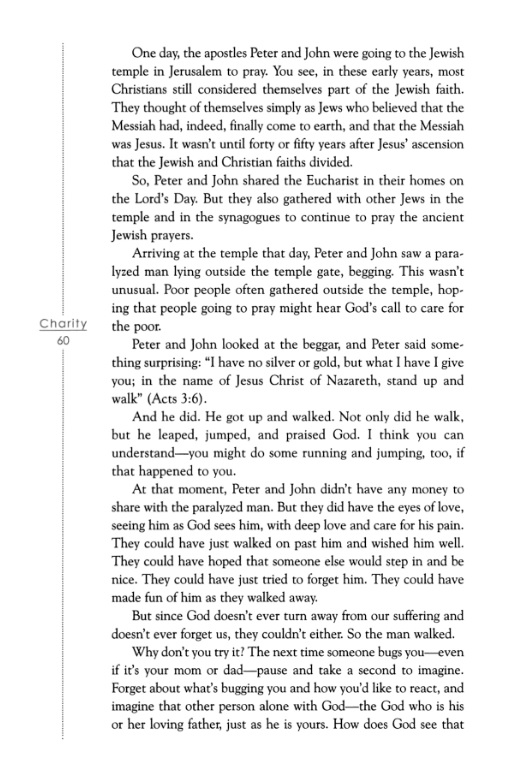
The first reading, from Acts - a page from The Loyola Kids Book of Heroes from the section, "Heroes are known by their love."
amy-welborn-book
The Gospel is the narrative of the Road to Emmaus. From The Loyola Kids Book of Bible StoriesRemember, the stories are organized according to when we generally hear them in the context of the liturgy:


Sunday, April 4, 2021

Easter Sunday for Kids

  Images from entries from the Loyola Kids Book of Signs and Symbols and The Loyola Kids Book of Bible Stories by Amy Welborn. 

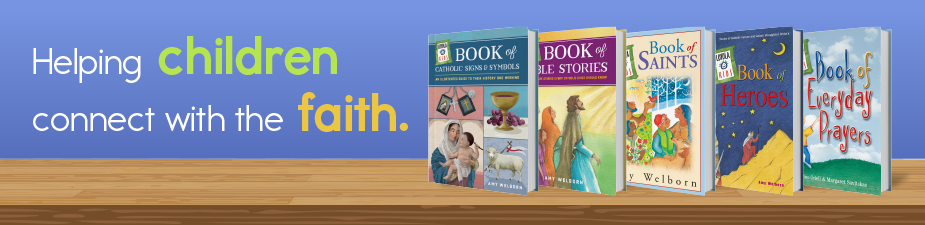
Whether you are looking to help children connect more meaningfully with the signs and symbols of the Church, stories from the Bible, lives of the saints and heroes of the faith, or prayers for daily life, you can rely on the Loyola Kids Series.

An illustrated sourcebook on the signs and symbols of the Catholic faith. Each image is coupled with a simplified and detailed description to benefit readers of all ages.

An illustrated collection of Bible stories for Catholic children, Loyola Kids Book of Bible Stories is uniquely arranged according to the liturgical year.


Saturday, April 3, 2021

Holy Saturday - Easter Vigil

 The Resurrection is one of the Glorious Mysteries of the Rosary.  Check out this small hardbound book,  Praying the Rosary by Amy Welborn and Michael Dubruiel.  Click on the cover for more information.

 
"Michael Dubruiel"


The Gospels show that the gaze of Mary varied depending upon the circumstances of life. So it will be with us. Each time we pick up the holy beads to recite the Rosary, our gaze at the mystery of Christ will differ depending on where we find ourselves at that moment.

Thereafter Mary’s gaze, ever filled with adoration and wonder, would never leave him. At times it would be a questioning look, as in the episode of the finding in the Temple: “Son, why have you treated us so?” (Lk 2:48); it would always be a penetrating gaze, one capable of deeply understanding Jesus, even to the point of perceiving his hidden feelings and anticipating his decisions, as at Cana (cf. Jn 2:5). At other times it would be a look of sorrow, especially beneath the Cross, where her vision would still be that of mother giving birth, for Mary not only shared the passion and death of her Son, she also received the new son given to her in the beloved disciple (cf. Jn 19:26-27). On the morning of Easter hers would be a gaze radiant with the joy of the Resurrection, and finally, on the day of Pentecost, a gaze afire with the outpouring of the Spirit (cf. Acts 1:14) [Rosarium Virginis Mariae, no. 10].


As we pray the Rosary, then, we join with Mary in contemplating Christ. With her, we remember Christ, we proclaim Him, we learn from Him, and, most importantly, as we raise our voices in prayer and our hearts in contemplation of the holy mysteries, this “compendium of the Gospel” itself, we are conformed to Him.
 

Friday, April 2, 2021

Amy Welborn in Living Faith

            Amy Welborn is a contributor - five devotions per issue -  to the Living Faith daily devotional quarterly.

For example, today, April 2.

We had, indeed, all gone astray, each following our own way. I, with my temptations and sins, and you with yours. But during these past few weeks, we have tried something different. Joined by prayer, fasting and almsgiving, we’ve followed, not our own way, but his. Together.

MORE

December 29 (written a year ago, before the Covid pandemic)

Another calendar year is drawing to an end. When I look back, what do I see? What emotions do the events of this year’s journey around the sun bring?  Perhaps the year has been dominated by sadness or discord, and we won’t be sorry at all to see it go.

MORE

 November 24:


Before the LORD, for he comes; for he comes to rule the earth.
Psalm 96:13

Advent approaches, and as we draw near to that season, the Scripture readings are all about the last things: death, judgment and eternity. These can be frightening to contemplate, subjects we might rather avoid. But we can’t. Here they are, presented to us in God’s Word. And, if we are honest, here they are in the ebb and flow of our lives.

MORE

 October 29:

In all circumstances, hold faith as a shield, to quench all the flaming arrows of the Evil One.

- Ephesians 6:16

On our last day in South Florida, we headed out to Biscayne National Park, hoping to see the Miami skyline and, if we were lucky, some manatees. We were surprised by a different sight: loads of well-dressed people waiting in line and then gathering under a large tent. We had happened upon a citizenship ceremony. It was quite moving. What struck me was that these people had such intentional pursuit and acceptance of rights and responsibilities with which I'd been born, things that I had hardly ever thought about.


MORE


 October 18

What to do? I called a neighbor and asked him to come help me change the tire. I called a friend and asked her to bring my son to where I was. I wasn't crazy about bothering folks at that time of night, but if I'd been called on the same kind of mission, I wouldn't have minded helping. We're all in this together. We need help, we give help. Paul didn't travel the known world inviting people to solitary relationships with God. He called them into community: into the body of Christ, called by him, there for each other.


MORE

September 24:

Vanity of vanities, says Qoheleth,
vanity of vanities! All things are vanity!
What profit has man from all the labor
which he toils at under the sun?
One generation passes and another comes,
but the world forever stays.

- Ecclesiastes 1:2-4

For a week, Copan Ruinas, Honduras, was home. We walked everywhere. And on our daily route, we passed her. Ancient and tiny, neatly dressed, she sat motionless in the doorway of the ice cream shop. If we caught her eye, she would smile slightly and return her gaze to the ground. Hundreds of years ago, kings and priests looked down at their subjects here from the heights of Mayan palaces, sure of their importance, confident in their legacy. Now, children scramble over the crumbling stones.


MORE


 April 27:

My wallet was old and bulkier than I needed. It was also patterned in a hideous pinkish paisley. But it had been a gift from my son, who, as he proudly told me on that Christmas morning years ago, had picked it out all by himself.


So, not wanting to hurt his feelings, I kept it. I recently mentioned the situation in passing and that same son said, "Well, why don't you just get a new one?" 


MORE

April 3:


I love you, O LORD, my strength,
O LORD, my rock, my fortress, my deliverer.
- Psalm 18:2-3

My youngest son and I recently headed to the Badlands of South Dakota. I had seen photographs of the layered, varicolored, almost lunar landscape, but the reality of what I encountered surprised me. I had assumed the formations we'd be walking among were solid rock--but they're not! They're sediment. Essentially huge piles of crumbly, dried mud. No wonder I'd not been able to find any rock-climbing activities for my son. You'd tumble right down if you tried. And no wonder this park, unlike any other national park, permits open, off-trail hiking. It's all going to erode anyway, and fairly soon in geological time.


MORE

 March 12 - 

Last year, we spent a couple of weeks in Seville, Spain. Around the corner from our apartment was a church with a forecourt. In the rear of this courtyard stood a statue of St. Jude Thaddeus. Any time I walked past, day or evening, I saw the same sight: a steady stream of people coming in from the street--passing by on the sidewalk bearing briefcases, shopping bags and backpacks, young and old--stopping in to light a candle, offer flowers (there was always a bank of bouquets in front of the statue) and stand for a moment and pray.


MORE

For example, today - February 9.

We live, it seems, in a time in which political talk never, ever ends. And about this time in the four-year election cycle in the U.S., it's reaching a peak. Sometimes the intense emotions and judgments that characterize these conversations lead me to wonder if people are looking for a competent government leader or something more profound in a spiritually barren time.


MORE

 January 31:

Place Uriah up front, where the fighting is fierce. Then pull back and leave him to be struck down dead.

- 2 Samuel 11:15

What a terrible, wretched incident this is: David, the Lord's anointed and King of Israel, has an innocent man killed so he can have his wife to himself.

And how striking it is that God's people didn't hide this horrifying sin. In reading the Hebrew Scriptures, I can't help but be struck by their honesty and, indeed, rawness at times.


MORE

 January 13:

In the midst of one of these situations, of course I was moved to pray. First, for a resolution to the situation that involved no loss, either of material goods or my pride. "Please fix it," I asked God. "Thanks." But then a different prayer came to me, a simpler one: "Help me bring good out of this."


MORE

January 7:

I would have just driven on by. But my son, always alert to the mysteries that nature holds, had been paying attention, so he was able to see. And so Magi, wise and observant of God's ways in the world, were led by the light to his son.


MORE


December 26

 December 19:

During Advent, in these days leading to Christmas, my days and evenings are marked by familiar rituals of all kinds.

I pray at Mass, of course. And in the Scriptures, prayers and music, I am eased into the journey of waiting and hope. Candles glimmer from my mother's Advent wreath. We hang the wooden "O Antiphon" crafts my sons made years ago. The lights, the recipes, the scents of these days create a place that I know.


MORE


November 17

Last Thanksgiving, a local restaurant offered a free meal. If you could pay, fine, and any money would go to a shelter. If you were unable to pay, that didn't matter. The doors were open, the table was set, and you were welcome to the feast.


MORE

 November 5:

I am surrounded by people just trying to do the right thing. Sometimes we make the right decisions, sometimes the wrong ones. We correct our mistakes, try to do better and bear it all patiently, never forgetting our own limitations and our own missed calls.


MORE

October 4:

He was called Il Poverello--the little poor one--and we very strongly and rightly associate St. Francis of Assisi with poverty. We love him because in him we see that it is, indeed, possible to live the call of Jesus, to follow in a radical way, with nowhere to rest our head, trusting in God alone on the journey.


MORE


amy welborn


Recently:


The webpage for Living Faith is here.

Living Faith is a print publication - available in Spanish and English - but a digital edition is available as well.

More information on the digital edition is here. 


Follow Living Faith on Facebook and Twitter.